Sunday, March 3, 2013

Watching "Trout TV Show" yesterday


Yesterday got to be a bit too much inside time. I eventually turned on the television, and I found "Trout TV"  (see www.trouttvshow.com)

trouttv

I haven't seen this show before, mostly because I rarely watch tv, but it was a great distraction for the boys....and it turned into some teaching points for my four-year-old.

The show was dry-fly-fishing on the Teton River, a 90-minute drive from our house. It looked AWESOME! They were drift-boating, but I could see myself bushwhacking along the shore on that river. Definitely some great fishing to be had up there. I've always had the Teton River in the back of my mind, but now it has moved up to the front a bit closer. I think I'll wait a year til Paul is a bit older because it looked like the water is a bit "bigger" than I really want him to be around right now.

But they were catching nice fish on a beautiful river!

Then I checked out their website. It's easy to cruise around, and they have a cool shirt for sale.


604367_MissedCall


Check them out when you get a chance.

Monday, February 25, 2013

Best backcountry campsites for really young kids (2-6 years old) in Yellowstone National Park


It's winter time, and we're all enjoying the great outdoors, skiing and ice-fishing, right?
Just around the corner on April 1 is the lottery for Yellowstone Backcountry campsites.  To get the good sites on the good days, you have to be ahead of the herd and get your "lottery ticket" submitted. This post is one of several from BackcountryCutts to help you in planning your Yellowstone Backcountry trips (see www.backcountrycutts.com). 

If you're thinking that you have to wait a few more years to hit the Yellowstone backcountry because you have little kids who can't walk too far or you don't want to risk all the things that can go wrong in the backcountry, this post is for you.

Or, if you are concerned about the physical abilities of someone in your group, these campsites can be considered as starting points for journeys into the backcountry.

There are indeed sites that are suitable for young children.  And, it's incredibly important to help your young children build a foundation of outdoor activity for their lives and also build a love of the environment to help our next generations maintain the "wildness" of places like Yellowstone National Park and the true "wilderness" sections of our nation.

This is THE YEAR that I get out into the backcountry with our four-year old. I wanted to do it last year, but the pieces just didn't fall into place. That was the first year that Paul was potty-trained, so I had great schemes and plans for that.  I don't think taking diapers into bear-heavy-backcountry is a good idea for various reasons. In any case, we got some good car-camping in but no backcountry.
So where are these magical places in the Yellowstone National Park backcountry that are good for little kids?

First, let's talk about the criteria for each spot.

1. Proximity to the car: I'm no idiot. I want the quickest and easiest bailout-plan possible. That means the spot has to be close to the car. This is generally less than two miles. I can cover that in 30 minutes while carrying my near-40-pound four-year old. This is for safety reasons as much as sanity reasons.

2. Flat trail: I want my kid to walk the entire way. That means it has to be flat so he can actually do it.  When he walks, he gets the satisfaction of walking a long ways, and he'll also (hopefully) get tired enough to go to sleep when the sun goes down. And flat is good for Daddy, too, because I'm carrying a bit of extra gear.

3. Near appropriate water: I like to camp near water, mostly to make camp-life (ie getting water for morning coffee!) but also for the  ambiance...you know, the "babbling brook" scene.  But when you put little kids into the picture, EVERYTHING CHANGES. You MUST be careful and ensure you have "appropriate" water. By "appropriate," I mean it's small enough that the child in question can play in and around it safely, weather permitting of course.

Of course, the physical ability of the people in your group is the limiting factor. Some four year olds might be able to hike five miles in a day, but an adult can only do three. Keep that in mind, please. There are some GREAT spots just four miles from the road. I've mostly limited the camps here to three miles from the road.  And if you're wondering about camps along the Yellowstone River and Slough Creek, they are not mentioned here because, even though they are only 4-5 miles from the trailhead, they include terrain that is not generally flat.

And, PLEASE be BEAR AWARE in your campsite.

1. A few campsites in the Old Faithful area, specifically OD1. This is probably the absolute easiest for young kids. It is one mile from the trailhead, absolutely flat, and you can bike in. There are no-kidding bathrooms (pit toilets) about a mile from your car (two miles from camp). The Firehole River is very pretty and manageable in this area, including good fishing.  Think about it....if you have a bike trailer of some sort, you can pile everything in the bike along with the children and bike one mile from your car.  If you need to bail out quickly, you grab all the kids and "bear-aware" items (like food, etc) and throw them in the trailer. Ten short minutes later, you are at your car, and three short minutes later you can be at a campground where your better-half is sleeping in your camper.  The first go for your child in the backcountry can't have a better setup than this!

OG1 is 1.5 miles west of the Fountain Flats trailhead. Completely flat. Can be "marshy," so might have some bug issues.  A creek.

OD4 is about 2 miles from the Fountain Flats trailhead. Completely flat. Can be "marshy," so might have some bug issues. A creek.

OD1 is away from the water and 4.3 miles from the Fountain Flats trailhead. You could bike half-way then walk. Try other sites first.

Old Faithful Camps


2. Up the road from Old Faithful, going north via Norris and fairly close to Mammoth, is Indian Creek and Campsite 1B1. This is a really nice area. A bit higher elevation, so it's cooler....just something to be aware of.  The campsite is about 1.8 miles from the trailhead and a flat walk. The creek is great beginning in July, and there aren't alot of bugs. Check with the Ranger Station to see if Indian Creek still has some special, kid-friendly fishing rules.

Indian Creek Camps


3. West of Canyon Area are Ice Lake, Grebe Lake, and Cascade Lake. Of the three, I prefer Grebe Lake.  During one of my trips to Grebe Lake three years ago, a couple of the group saw a large pack of wolves in this area, walking and fishing the Gibbon River between Grebe Lake and Wolf Lake (not listed here but in the vicinity).

Ice Lake has the closest campsites, and they are all between 1 and 2 miles of mostly flat walking. The lake is an average lake in Yellowstone.

Grebe Lake campsites (recommend 4G2 or 4G3) are a bit further, between 3-4 miles, with an undulating but generally flat walk in. These campsites have some nice tree coverage, and there are Arctic Grayling in Grebe Lake!

Cascade Lake campsites 4E3 and 4E4 are about two miles in after flat walking. This area can be quite marshy before mid-July and after heavy rains...that means bugs. The fishing in Cascade Lake can be pretty good. And if you have a more adventurous, older child, the view from Observation Peak is a must-see (but it is kind of tough for young legs to get to).

Canyon Camps


4. Near Roosevelt and Tower are the Hellroaring Creek campsites. These have a significantly steep hill to get down for starters, and that should be considered for both going down and coming back up on the way out. Outside of this hill, campsite 2H3  is AWESOME,and 2H4 is pretty nice, too. Hellroaring Creek is a great creek in August; the perfect size (ie depth, speed, volume, and with LOTS of rocks for little boys to throw) in August. On the way, there is a large bridge over the Yellowstone River that is sure to put any little boy or girl in awe. To get to 2H3, you have to ford the creek (not hard at all, but you might consider carrying little kids...still very doable), or you can take a long way around to go over a small bridge, adding a couple miles. 

You can spend a day exploring upstream from camp, or going down to the confluence of the Yellowstone River and Hellroaring Creak, which is a really neat area (and good fishing)....be careful with kids at this confluence because the Yellowstone River runs very fast through the canyon here! Also, know that this is significant bear country. Other family members could stay at Roosevelt area during your backcountry night.

Hellroaring Camps


5. Moving west some more are two sites on the Lamar River, one of which is a favorite spot of mine in the park. About 3.5 miles upstream from the trailhead are campsites 3L1 and 3L2 at Cache Creek. 3L2 is preferred because it is in a nice, old-growth section of trees, with clear ground for kids to run around. Cache Creek is about 30 yards away and a good size for little kids (and good fishing for them, too!), and it is close to the Lamar River for exploring and fishing. The hike in requires an easy ford, and it has beautiful views. I think some young children might get bored on this hike because you can see forever, which makes it feel like you are moving very slowly. But once you get to 3L2, there is plenty of great areas for kids to play. Again, Cache Creek is very nice and has far more rocks than any little boy could throw in a few days!  Be aware that this is significant bear country.

Lamar Camps


6. Lastly are the camps in the Bechler River area. They are last because you only want to go here in August and September. Before that, you will be eaten alive by mosquitoes. After that, you will be cold and wet. Neither are fun for adults or the kids. This is incredibly flat country, so walking is easy. But you can see a long ways, which makes it feel slow. The creek and river in this area are really slow and generally shallow, but very cold. Sites 9B1 and 9M1 are about three miles in, but if you can go another two miles (total of five miles), campsite 9B2 is really nice!

Bechler Camps

Sunday, February 17, 2013

Backcountry Bucket List #3: Figure Out Who Pooped In The Park


This is #3 in the continuing series of posts from The Backcountry Bucket List.
***************************************************

3.  Figure Out Who Pooped In The Park

One of my favorite books is "Who Pooped In The Park?" Say what you will, but it's a truly awesome book! It's one of my three-year-old-boy's favorite, too (and he can identify many of the animals!). Did you ever think that looking at poop could be fun?

I honestly don't know if "fun" is the right word here, but it is a great excuse to catch your breath while on the trail, identify who might be living in or near a campsite you've chosen, and could help you look smart around your friends. Not to mention that it is actually a safety skill that can come in handy.

This is admittedly strange if you've never thought about poop as other than a gross, yucky substance you want nothing to do with. But you're in the backcountry now, and you should really pay attention to this sort of thing. You don't have to be Grizzly Adams or his buddy Mad Jack, but just a little knowledge can go a long way and make for some interesting discussion.

While hiking in Yellowstone National Park, you might come across a big, fresh, steaming pile. Ok, it probably won't be steaming...I threw that in for a bit of eight-year-old-boy humor that has to accompany any discussion of poop.

In reality, that large pile, when accompanied with the appropriate tracks, could be identified as something non-threatening as a horse or something a bit more interesting like a grizzly bear. With a closer look, you could also tell what he's been eating, of course, and that might indicate how healthy or hungry he is. All of this is good information to have.

If along your hike you come across an area of flat grass, your first question is inevitably "I wonder who slept here last night?" Well, poop can help find your answer. Look around and see what kind of poop in the area is freshest. Maybe it was an elk. Maybe it was a deer. You'll be able to tell by the poop. Who knew?!?!
Poop and tracks go hand in hand. You really should know a little about both. There are some neat  info cards that combine diagrams of tracks and scat of the various animals in the area you might be in. Take one along next time you're hiking, and spend some time looking at the ground.

***************************************************

On a side note, "Who Pooped In The Park" was an inspiration for my book "The Backcountry Kids."  If you have little boys, you MUST have "Who Pooped In The Park." 

Who Pooped in the Park? Yellowstone National Park: Scat and Tracks for Kids   Backcountry Kids

Thursday, February 14, 2013

Getting Yellowstone campsites and trails into Google Earth


I posted this a few years ago, I think, but it's worth posting again. 

** You have about six weeks to get your campsite requests in. See the backcountry planner page for more info. ****

As you plan your summer adventures, dreaming about the campsites and the trails and all the great places to see in Yellowstone National Park, a standard topo map is great. But Google Earth gives you some great information, too.

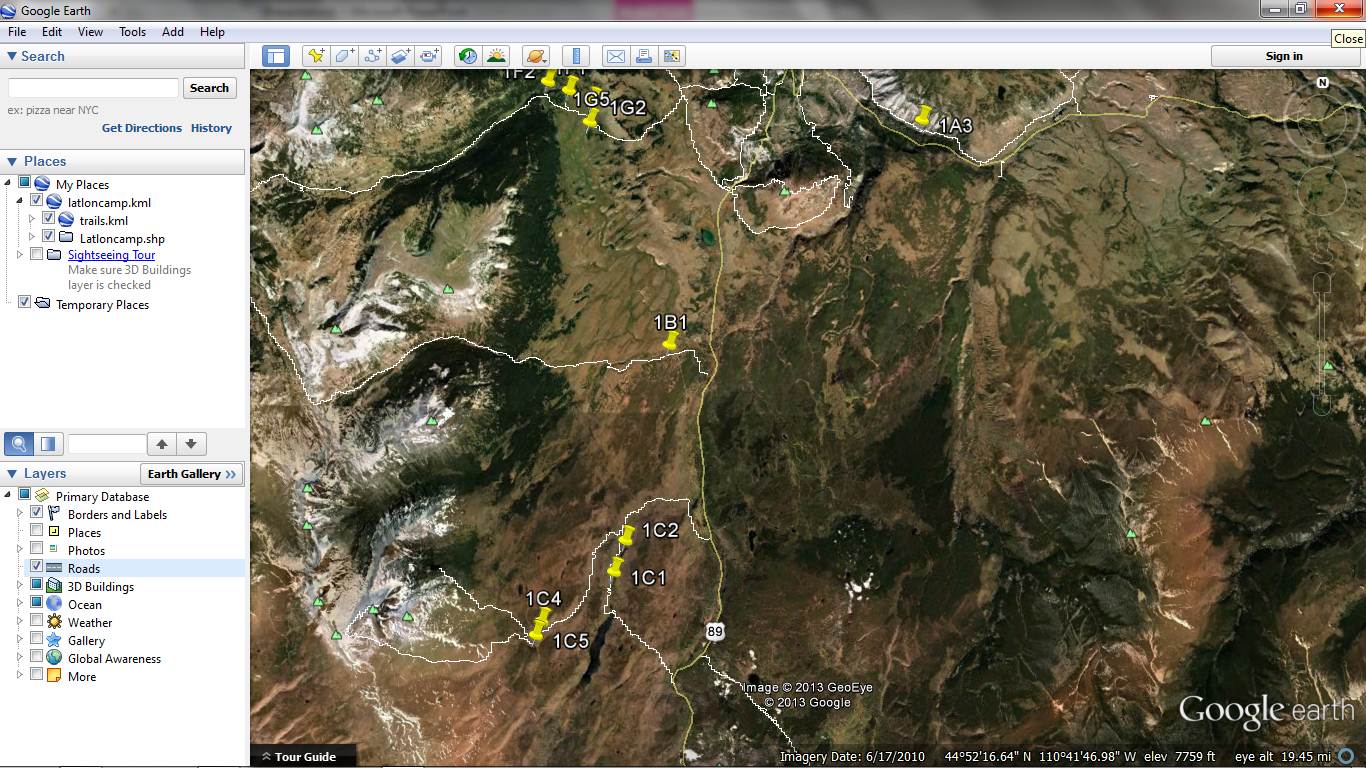
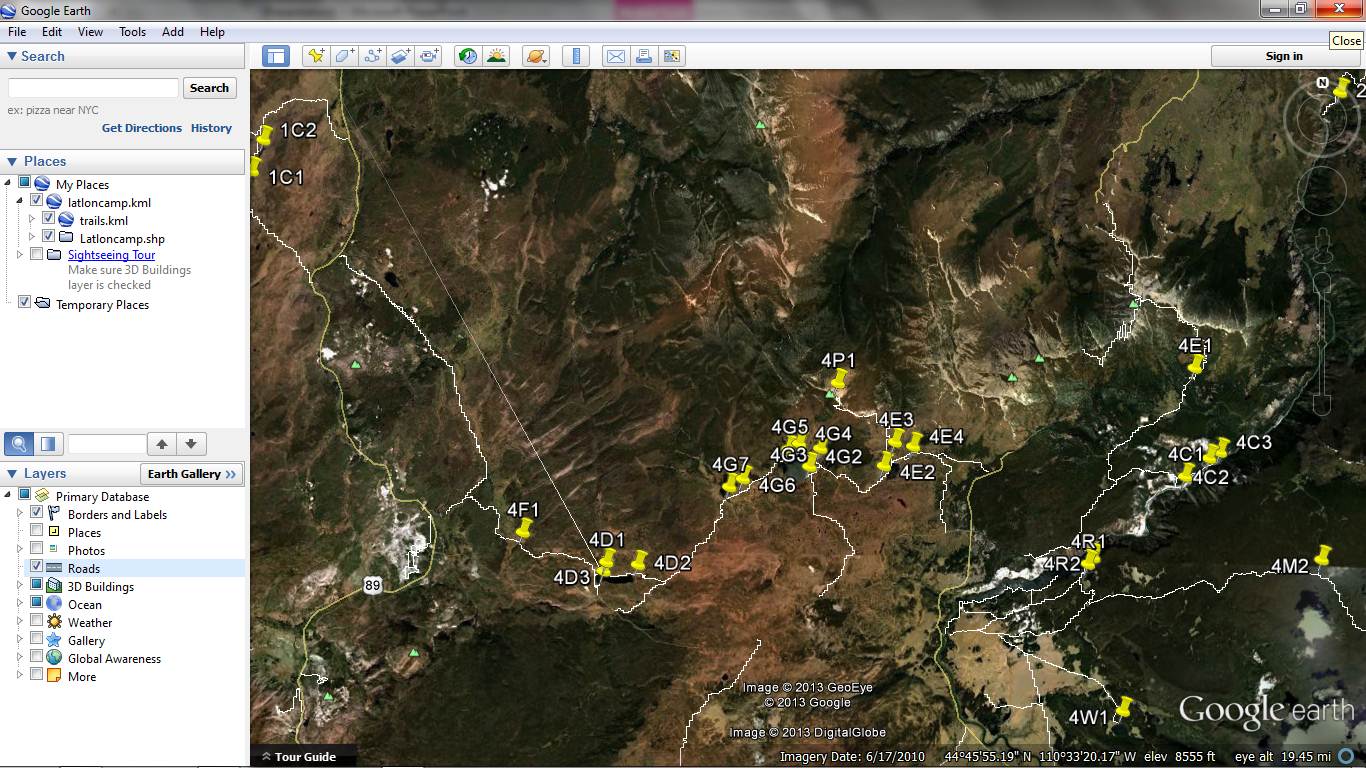
The Yellowstone Ecology website has the Google Earth files for campsites and trails. Download those files, then double-click on them, and the trails and campsites open up in Google Earth. Very nice!

ynpcampsingoogleearth

Getting your kids outside to keep them healthy

Yes, I know this is a fishing blog. However, in the bigger picture, it is actually a "family show based in the great outdoors with a focus on fly-fishing" (as the blog description says.) So this post fits in perfectly.

*************************************************


One of the new and improved ways of presenting information using infographics. They can really make you see information in a new way, so the infographics are a great way to present complex data of any sort.
I saw this at the AdventureParents website, and I just HAVE to pass it on. It's originally from the National Environmental Education Foundation.

Let's face it, it is common sense that kids who get outside are going to be healthier. But sometimes, "how you say it" is more important that "what you say."

Thus, I don't have any other comments for this infographic other that please pass it on to everyone you know.

Outside Kids are healthier

Saturday, February 2, 2013

Cool bird fishing photo


This is from my favorite fishing blog, FlyFishYellowstone.blogspot.com  They didn't attribute the photo, so I can't. But it's SUPER COOL.

THURSDAY, JANUARY 24, 2013

Sunday, January 27, 2013

Backcountry Bucketlist #2: Sit and Listen


Many of us go hiking or spend time "in nature" so we can "unplug" or whatever you want to call the act of getting away from the normal hustle and bustle of the world.
IMG_1614

Of course, that hustle and bustle is normally loud, so we might tend to tune people out while we think about the hundred other things we need to be doing while talking to someone.

Nearly every communications skills and soft-skills leadership class will tell you that "active listening" is key to good interpersonal communications. Instead of thinking of our own comeback and what we'll say when the other person quits talking, we should be actually listening to what that person is saying! Crazy talk, right?! 

I'm here to tell you that "active listening" is a great activity for the backcountry. The soft-skill leadership books are right; if you want to truly understand what you're listening to, you have to really listen. Sit down. Shut-up. Just listen. Hear what nature is saying. It's kind of like the old saying "stop and smell the roses," but you're stopping to listen to the land. But what does that really mean? How do you do that? 
My favorite way to just sit and listen is to find a nice meadow or woodsy area in the backcountry that is only a short walk from the tent. A short walk is normally no more than a couple minutes, but it could be up to ten minutes.

Anyway, when you find that spot, start thinking of when you want to visit. Dawn and dusk are great and have the best opportunity to see animals like bears or wolves if you are in Yellowstone National Park. The heat of the mid-afternoon will be a fairly dull time to sit and listen, but on a cool fall day mid-day could provide a great nap-time, too.

Sitting and listening with a hot cup of coffee in the cool morning or a nice warm dessert of some sort or a hot tea at dusk is very soothing. My favorite time to sit and listen is in the middle of the night, and I'll add some specific moments about that at the end of this in hopes it will entice you appropriately to get out of bed at night. 

So how do you "sit and listen" and what's this all about? This is as simple as it sounds....you just sit and listen. Get comfy leaning up against a tree or something. You can take some minor distractions like a cup of coffee, binoculars, or pen and paper. You really should take a camera if you like backcountry photography. That's about it for distractions.
An evening coffee on beach of YNP camp 6B4.

Don't take your cigarettes or Copenhagen because the smell really does travel a lot and might keep some of the animals away (once you get away from the smells for a week or so, you'll notice they really are that strong). A lot of people are hooked on their portable music, but I recommend you leave that in the tent, too, so that you have all five sense available to you for safety if no other reason.

Pretty soon, something will catch one of your senses. A deer walks through your meadow. A wolf pack trots through. A grizzly turns over stumps looking for breakfast. A sandhill crane sounds-off with its morning call. On a cool, October morning in the Rocky Mountains, a bull elk bugles for his girls. Fish start jumping. Geese honk as they fly overhead. A bald eagle cruises above the river looking for food. As the sun rises, the dew disappears from the ground cover. 

As the sun sets, the colors of the alpine-glow shift to deep oranges and then fade to black before the full moon returns to provide a contrasting white glow. 

Plan anywhere from 10-15 minutes to maybe an hour of "sit and listen" time. Get comfortable. Use the binoculars to zoom in on a particular bird fluttering in a nearby tree or to see if that big bird flying over the lake is an eagle or an osprey. I think you'll find at least a few memorable things each time you sit and listen. 
One thing that you might not think of but is actually really cool is to go to that spot in the middle of the night, especially if it's a full moon or new moon. The full moon in the mountains gives an incredible amount of light, and you'll be amazed at how everything looks and feels at night under the full moon. Hint, check the lunar schedule to know what night the full moon is and when during the night it is at its peak.

You probably won't see any animals in the middle of the night, but it will indeed be a memorable evening if a wolf starts howling, an owl starts hooting, or some animal starts making noises and you don't know what that animal is...or where he is! Sound travels incredibly well during the calm nights. 

A new moon is star searching time. If you haven't been out of the city-lights aura in quite some time, you really should schedule this during your trip to any national park or other nature area. The stars are amazing. If you don't want to set an alarm clock to get up, drink a lot of water before going to sleep. At 2:00am, you'll need to get up and pee, which is perfect!

You're already up and out of your tent, so spend a few extra minutes star-gazing. A word of warning....dress warm if you are in the northern mountains or make sure you have some bug protection on if you are in the humid south. 

I've seen a lot of stars in the backcountry, but there are three times that really stick out in my mind. I hope you get a chance to see something like these.

While at the Granite Park Chalet in Glacier National Park on a summer hike, my wife got up in the middle of the night and then decided I needed to get up, too. I had just barely got to sleep because of the very thin walls and noisy beds and mattresses in the bunk rooms, but I got up even though she hadn't told me why. Right after stepping out of the bunk room, I knew immediately why she got me up.

The most impressive star show was on full display! The view was directly out of the textbooks, with so many stars I had never seen before, even with the many nights in the backcountry. I'm pretty sure I could see the swirls of the Milky Way Galaxy. 

At Charlotte Lake in the Southern Sierra Mountains in King's Canyon National Park, the moon was full and the stars were bright. Two nights in a row, I woke up in the middle of the night, complaining that somebody was flashing a light in our tent.

My wife was kind enough to put me at ease by simply reminding me that the light was the full moon that was strong enough to wake me up! After the moon woke me up the second night, I got my wife to step out of the tent for a bit to do the "sit and listen" bit.

We sat on a rock by the lake and enjoyed the moment. Then we noticed that the stars were no-kidding twinkling on the water of the lake. I thought that was just in the songs and poetry, but there it was for real. All I had to do to see it was to be out of my tent late at night and then "sit and listen" quietly and notice what was going on around me. 

Finally, while staying near Hellroaring Creek in northeastern Yellowstone National Park, I lay awake one night listening to an owl hoot so loudly I swore he was in the tree above me. "This is so cool. He's right above me!" I thought. When I told my fishing buddy, Roy, about it the next day, he was certain that same owl was above his tent all night, too. In any case, the hooting was loud and went on forever. 

IMG_0623

Monday, January 21, 2013

Backcountry Bucketlist #1: Go Jump In A Lake!


One of the perks of a triathlon lifestyle is that it keeps you shape for other things in life. One of those "other things" for me is the opportunity to hike into the backcountry and enjoy the great outdoors.

A while ago, I published a book called "The Backcountry Bucketlist," and I want to begin sharing some of those items with everyone as the deep of winter has set in and it sometimes takes daydreams of things like this to keep us going.

Don't worry, this blog is still about TRIATHLON! But these little bits can help keep things in perspective and maybe give you a few ideas of things to do and see on your next destination race.

****************************************************

We've all seen it...that crisp clear mountain lake, sitting completely still on a hot August afternoon. Not a cloud in the sky. Not a breeze in the air. The water is crystal clear, and you can see twenty feet to the bottom from the six-foot-high rocky outcropping you stopped on to take a break.


You're all hot and sweaty from a couple hours of hiking up that darn hill. Your feet are dusty and nasty from the trail. Yeah, what you wouldn't do for a cool dip in that lake.

But you know that some of the water in that lake was part of the snowpack just a couple days ago. That means that water is...what?...sixty degrees? How does that compare to the pool back home?  The announcer for the Olympic Games said the water in the pool that Michael Phelps swam in was 78 degrees.   For good measure, you manage to dip your hand in the water. Yowzaa! It's cold!

Which is EXACTLY why you need to jump in!


There is simply no other time in life you will feel so incredibly alive like you do when you jump in that mountain lake on a hot day.  And, you're going to do this the old-fashioned way...in your undies.


Creep up and put your toes on the cliff. Stare down. Back up and think about it. Repeat several times.  

Countdown and go!  Those two seconds with your arms flapping in the air are pure joy and terror at the same time.


The cold water zaps you and takes your breath away. Your heart pounds out of your chest! You try to swim back to shore, but all you can manage is some sort of weak doggy-paddle because your muscles are shivering so much.  After ten seconds that feel like an eternity, you reach the shore and pull yourself out.


Friends are laughing while you shiver to the bone and get into the sun. As you warm up a bit, you realize just how AWESOME that was.  Then, that little eight-year old kid in you that you suppressed so long ago so you could make it in the "adult  world" comes right out and yells "Let's do that again!"


Trust me on this one. It's first for a reason.

Monday, December 31, 2012

Winter Planning: How to get to Yellowstone Nat'l Park from far away

As the new year comes in, alot of us are probably thinking about our goals for the year. And, somebody out there might be thinking about finally getting out the Yellowstone National Park for that once-in-a-lifetime fishing trip they've always dreamed about.

Here is an excerpt out of the "Yellowstone's Backcountry Cutthroats" about how to get to Yellowstone National Park if you can't just drive in a couple of hours. If you're thinking about that trip for this summer, now is the time to start looking at airfares to save money.

If you like this portion, you can get the whole book on Kindle or Amazon.com for a hard-copy.

Yellowstone's Backcountry Cutthroats


*************************************************

Get To The Trailhead
Getting to your trailhead is not as straight-forward as you might think. Obviously, you can get in a car at your home and drive straight there. But, some people fly into area airports and rent a car from there. You could also drive to a gate city and get a shuttle for out-and-back trips, loop trips, or for trips that have different start and end trailheads.

The biggest issue with planning your arrival at the trailhead is the amount of time it takes to get through the park. The speed limit is 45mph on the roads, so that is significantly slower than 75mph on an interstate. Then there are the bear-jams, which are traffic jams caused by people stopping on the side of the and walking in the middle of the road so they can see a bear, wolf, and the elk. You might also get “stuck” behind a massive RV travelling 35mph.

At night, you should plan on driving only 35mph because most other drivers will be driving that speed, and it’s probably a smart thing to do so you don’t hit an elk on the road, which will definitely ruin your trip (at best). Driving slowly should also be considered as a respect to the wildlife, such as your chances of hitting one and killing it are reduced if you’re driving more slowly.

You can fly into an airport and rent a car. Salt Lake City is the closest hub airport, and Jackson, WY and West Yellowstone, MT are the closest airports. Jackson airport is about forty-five minutes from the south entrance, and West Yellowstone is right next to the west entrance. Both end up adding about $200-$300 onto the overall price of a flight, but depending on your specific situation, it might be worth it to fly into those cities instead of Salt Lake.

I have not flown to Yellowstone National Park because I live a 2.5 hour drive from West Yellowstone. Considering the amount of time it takes to drive from an airport to the park, you’re probably better off driving to the park in your own car if you are less than ten hours away.

Considering the time it takes to get to your own airport, get through security, wait for your plane, fly, and then get your rental car and then drive the four hours to the park…..well, you can see that that’s already about eight hours of your time. Having your own vehicle provides much more flexibility for you during your trip, including seeing a few other National Parks or fishing areas on a bigger summer trip. You might want to stay longer or have to go home. Logistics can be expensive if not done right and done without consideration for flexibility.

You could also get a car shuttle from one of the various providers in the area. I don’t provide a list of the providers because it seems they always come and go each year. Your best bet is to search the internet. In four years, I have not successfully coordinated a shuttle service, except one.

The shuttle service I was successful with is a great service at the Lake Marina that can shuttle you and your canoes to Promitory Point, making a trip to the upper Yellowstone River (above the lake) feasible in one day going in and only one day going out instead of a minimum of two days getting in and two days getting out. It’s a bit expensive, but if you want to be in the area that is known as the area in Continental U.S. that is farthest from any road, it works very well.

There is no basic bus service inside the park. If you’ve been to Yosemite or Zion National Parks and loved the bus system, you should be sorely disappointed that kind of bus service is not available in Yellowstone. There are many tour busses, but no shuttle busses.

Thursday, December 27, 2012

Ten things to look for in a point-and-shoot camera for the backcountry


If you're wondering what kind of camera you need to capture an active lifestyle, this is what you are looking for.

These are a few features to look for in a good point and shoot camera that you'll take along on your active lifestyle, year-round, all-climate adventures.

1. Drop-rated: Many of these new point and shoot cameras are rated for 10-foot drops. With kids who want to play with it, a drop-rating is an absolute must, and ten feet seems reasonable. Oh yeah....it's not just the kids who will be dropping it, right?!?!

2. Waterproof: I wanted waterproof because we love to be by the water, whether it's fishing or the pool. Standard waterproof-ness goes to 30 feet these days. You probably don't need more. And don't go for a camera that uses a case...why? because the case can break and then you have to buy another case. I personally think that the seals and such in a waterproof camera body will outlast the external case...I've had two Sony cameras that attest to the non-durability of an external case.

3. 1080 video: yes, you need 1080 video capability going into 2013 and beyond. 720 is not good enough anymore because of the playback on the big screen televisions. Don't go cheap on this! Get the 1080.

4. GPS: do you really need GPS? Probably not. I wouldn't be too concerned about this unless you are already using this feature.

5. WiFi capability: This is something I don't use currently but think I would if I was to get a new camera. It really is a kind of a pain to take out the memory card and put it in the computer every time I want to get my pictures on the computer.  And then how many times have I left the card in the computer?  Get this if you can, but it shouldn't over-ride any other features.

6. Moving parts: I like to minimize the number of moving parts in any gear that will be used alot in relatively harsh conditions. Every time you drop the camera, moving parts become less apt to move as needed.  Specifically, I don't like a shutter and lense that moves in an out every time you turn the camera on or off.

7. Battery adaptability: I say "adaptability because I don't really have a good word for the flexibility of a battery. You should be able to buy inexpensive replacement batteries and rechargers. The battery should be able to be quickly recharged. You should be able to recharge that battery somehow with a solar-charging device you might already have.  The battery should be rated to work well in the cold, too, although not many batteries do well in the cold anyway.

8. Ease of Handling / One-hand operations: the camera should fit in your hand nicely, have a nice grip to it, and be able to be be turned on on/off and zoomed with just one hand, preferably with gloves on. You should be able to have a strap attached to it, too.

9.  Function and Review options: You should be able to review a shot quickly and easily. This function gets into the handling and such, but it is also all about the software being intuitive and able to run through things quickly. You don't want to be sitting there on a cold, windy ridgeline trying to remember all the menu options.....you should be able to do things quickly with cold hands that have gloves on them.

10. Megapixels: You should get no less than 10 megapixels. I base this on the ability to print a nice 8x10 photograph. Sometimes you get really lucky with a point and shoot, and you get an awesome pic that you want to blow up. I've done a good 24x36 print with my 12.1 megapixel, but there is just a little bit of distortion visible to a regular guy.

*************************************

This is the camera I have now. It works pretty well for everything I need. I can use it with gloves easily, too!  It's about three years old now, and the only thing I wish it had is 1080 video; the 720 is what was available when I bought.

Product DetailsCanon PowerShot D10 12.1 MP Waterproof Digital Camera with 3x Optical Image Stabilized Zoom and 2.5-Inch LCD by Canon

These are the cameras I would probably buy today if I had to (luckily I don't have to. The Canon above is going strong!).

Wednesday, December 26, 2012

Cool Art:Brian Murphy Artwerkz

I was cruising through some fly-fishing magazines online recently, and I saw some REALLY COOL art that I wanted to pass on to others.

I found Brian Murphy in MontanFlyFishingMagazine.com online magazine.

His art makes me put thoughts into the minds of the fish. I just think it's really cool. Take a look! I haven't asked if I can post some of his art here, so I'll just give you the link to his art.

http://brianmurphymt.com/artwerx.html

Sunday, December 23, 2012

How To Get Your Toddlers Into the Backcountry


Ten years ago, my wife and I often went on long backcountry hiking trips with just some quickie planning. These days with 3 1/2 year old and 16 month old boys, we do more quickie trips with long planning time.  When I first started fly-fishing in the backcountry areas of Yellowstone National Park and the Sawtooths of Idaho, I could basically just tell my wife the when’s, who’s, and how’s of a trip and be on my way to paradise. That freedom has turned into clearing everyone’s schedules of many different other who’s and when’s to make clearance for us (on a side-note, the second or third Saturday in September is always reserved for some Lamar River action! And nothing can remove that day).

So, here we are trying to figure out how to get back into fun and fishing in the backcountry, or as close as possible to it, now that one of the kids can walk a few a couple miles each way. Our quickie-trips are generally a half-day scheduled around nap time, and the extended planning effort requires diapers, multiple snacks, safety considerations, and a couple of toys if we’re feeling energetic enough to carry them. The focus of effort is generally keeping the boys happy rather than hoping the fish take some fake food, but that’s how it is as parents of toddlers.

I’ve searched the Yellowstone maps for a place a couple miles off the road to provide some quiet from the road while also providing a safe place for the kids to play. The Lamar River about 200 yards upstream from its confluence with the Yellowstone River provides a two mile hike that the 3 ½ year-old can make on his own, a large gravel bar that provides some sand and many rocks for throwing, and a plethora of nice fishing holes in the immediate vicinity. Perfect!

map

gravelbar

I have a life-vest for the older boy, but I just can’t get myself to even make him put it on. I would rather watch over him like a hawk than squash his personal movement freedom with the life-vest. If we were rock-hopping and such along steep banks, it would certainly be different. As it is, the ground is flat, the water is barely-moving and shallow next to the gravel bar, and his Mom is there to watch like a hawk. All he wants to do is throw rocks and splash in knee-deep water, and at this location he can do that with the endless rocks and great little pool of water.

noahbar

The 16-month old is easier in some ways but harder in others. We have to carry him into the location using a baby-backpack (we use the Deuter Kid Comfort III…absolutely awesome and worth the high-price; it has lots of storage).  He’s about thirty pounds, so I get to carry him while his Mom carries the fishing gear and other stuff. Once at our location, he mostly sat in the sand and played with a little plastic rake. He can’t maneuver very well over the rocks yet, and that is mostly a good thing. 

When nap time rolled around, we put him on a little blanket we brought, and give a bottle of milk we kept cold in an insulated cooler made just for that type of thing (all you dads, take a look at baby gear to repurpose for your own needs, too!). We forgot the small shade-tent, but the canyon walls and some trees provided plenty of shade up on the banks of the river. He didn’t take a nap, though! So, we had reverted to Plan B and left for the trailhead before he got really cranky; he was asleep in the backpack before I took ten steps!

I almost forgot! I got a good two hours of fishing in, too! I went mostly up-river, but there were plenty of pockets in both directions. The catching wasn’t very good, but I got looks on nearly every fly…..my prep time was spent planning for the kids rather than researching what flies the fish would be looking for. Anyway, for me, half the fun is just getting the fish to say “yes” or “no” to the fly, and I was getting that answer as I watched them swim away.  It was a bit frustrating, but it beat walking the boardwalks with the crowds at Old Faithful.

Here are a few of the things to think about when you are setting up your trip to the backcountry with toddlers.

1.       Recon
-          Look at the maps for possible locations,
-          Visit the areas in person to look at safety factors and the trail to the site.
-          Look at the area in Google Earth, realizing that water depths are probably different. Check river conditions on USGS water gauges (http://waterdata.usgs.gov/nwis )

2.       Safety
-          You MUST have a water-safety plan of some sort: life-vests, always-in reach, small water, etc. Don’t under-estimate the dangers of the stream. These are little kids who don’t know better.
-          Consider the impacts of bear country. Follow the rules exactly, and all adults should have bear spray. Teach the kids not to run as a basic backcountry safety principle, but vitally important in a bear situation.
-          Check the weather before you go for heat, thunderstorms, rain, wind, etc.
-          Sunscreen your kids. If you forget it, go back and get it. That goes for bug spray, too.
-          Take a shade-tent and a ground-cloth or blanket for protection from elements.
-          Have plenty of water. Take a filter to make sure you don’t run out.
-          Keep the distance short. Tired kids trip and hit their heads on rocks; beyond the health issue, if the kids get hurt, they probably won’t want to go back.
-          Take a first-aid kit with a small ice-pack for any bumps and bruises.
-          Continuously ask yourself “How could my kids get hurt, and how will WE deal with it?” There’s no 911 in the backcountry.

3.       Plan For Fun
-          If they are old enough, this might be the perfect time to teach your kids to fish!
-          Boys love throwing rocks and playing in sand. Make that a priority.
-          Take some familiar toys with you (yes, jam them in your pack, it’s worth it!).

4.       Kid Care Items
-          Snacks are almost as important as all the safety factors. Take a variety and enough for lunch.
-          You CAN take real milk. Put it in a basic lunch drink cooler.
-          Have a nap plan.
-          Dress your kids for the environment: shoes, shirt, pants vs shorts, hat, etc.(rain gear?!)
-          Don’t forget diapers/wipes/ etal. Remember a bag for the messy diapers (pack it out!).

We had about four awesome peaceful hours in the near-backcountry on this trip, including the excitement of a coyote following us quite closely, the constant sound of the river with no road-noise, and the opportunities to see wildlife up close. Our oldest boy walked the entire way, which is really awesome (insert proud Dad grin here!), and the youngest definitely wore himself out for the day. And Dad got to fish while Mom stayed mostly happy; I say “mostly” because she got to fish for only about fifteen minutes. 

Absolutely most importantly, we are building the foundation of a love for the backcountry that I so deeply hope turns into future long backcountry trips with quickie planning.